
Garage Floor Coatings

Garage Floor Coatings in Dothan, AL
A garage floor coating looks like a simple product. You roll it on, it cures, and the floor is sealed. That is the pitch. The reality is that a coating is only as good as the slab underneath it. Concrete is porous, and it moves water vapor up from the soil continuously. When you seal that slab with an impermeable resin, the vapor has nowhere to go. It collects at the bond line, builds pressure, and eventually pushes the coating off in sheets .
That is the failure mode that matters, and it has nothing to do with the brand of coating. It has everything to do with what happened before the first coat went down. We install garage floor coatings across the Wiregrass with the slab treated as the deciding factor. If you are planning a project, you can request a garage floor coating estimate and we will test the slab before recommending a system.
Why Garage Slabs in Alabama Are Different
Concrete in a humid climate behaves differently than concrete in a dry one. In @fname@ and the surrounding Wiregrass, two conditions stack against a coating.
Moisture vapor is always moving. Under a slab, the soil holds water. Above it, the garage air is usually drier. Vapor moves upward through the concrete continuously, looking for somewhere to escape . Bare concrete lets it evaporate. A coating traps it. When the vapor reaches the bond line and cannot pass, it collects and pushes.
Clay soil holds water against the slab. The clay-heavy soil in this region stays wet long after rain. That keeps the moisture supply under the slab steady, which means the vapor drive does not stop when the surface looks dry.
Humidity affects the cure, not just the slab. High ambient humidity during installation can cause some coatings to cure with a hazy or blush finish. Polyaspartic systems tolerate humidity better than standard epoxy, which is one reason they are common in Alabama garages .
New slabs need time. A freshly poured slab holds mix water that has not left yet. The rough rule is 30 days per inch of slab thickness before coating, so a typical four-inch garage slab needs months, not weeks .
Testing the Slab Before Any Coating Goes Down
The test is the part most cheap quotes skip. It is also the part that decides whether the floor lasts.
The plastic sheet test. Tape a square of plastic to the slab and leave it for 24 hours. If condensation appears on the underside or the concrete darkens, moisture is moving through the slab . This is a basic field check, not a lab result, but it catches the obvious cases.
Calcium chloride testing. A dish of dry calcium chloride is weighed, sealed under a dome on the clean slab, and left for 72 hours. The weight it gains tells you how much vapor came out of that patch of concrete. Most resin systems want to see 3 pounds or less per 1,000 square feet per 24 hours .
Relative humidity probes. A probe is drilled into the slab, usually to 40 percent of its depth, and left to equilibrate for three days. Most systems look for readings under 75 to 80 percent relative humidity . This catches a slab that has a dry top skin over a wet core.
Why it matters. A slab that looks bone dry can be pushing water vapor every hour. A coating applied over that slab can look perfect for months before it delaminates. Testing turns a guess into a number, and the number decides whether a moisture-mitigating primer is needed before the coating .
Surface Prep: Grinding Beats Etching
The second most common reason garage coatings fail is poor surface prep. The coating has to bond to the concrete, and it cannot bond to oil, dust, sealers, or a smooth troweled surface.
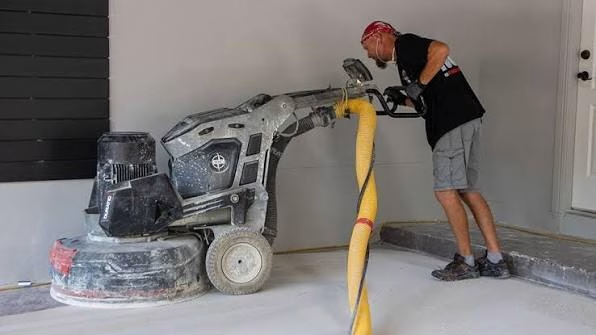
Diamond grinding. This is the standard for a durable coating. Grinding opens the concrete pores and creates a profile that the coating can grip. It also removes surface contamination, old sealers, and laitance . It produces dust, so containment and vacuum equipment matter.
Acid etching. A cheaper alternative that works on clean, unsealed concrete. It is less consistent than grinding, and it does not remove oil or sealers effectively. For a garage that has held cars for years, grinding is the more reliable prep .
Oil and grease removal. Degreasing comes before grinding. Oil that has soaked into the concrete has to be pulled out or the coating will not bond in that spot.
Crack and pit repair. Cracks and spalled areas are filled and leveled before the coating goes down. Older slabs typically need more of this than newer ones .
Epoxy vs. Polyaspartic: What Each One Does
Both are common garage coating systems. They behave differently, and the right one depends on the garage and the budget.
Epoxy. A two-part resin and hardener system. It is the workhorse of garage coatings: durable, versatile, and less expensive than polyaspartic . Epoxy is prone to yellowing when exposed to UV light, so it is often used as a base coat with a different topcoat over it. It also has a longer cure time, which means the garage stays empty longer.
Polyaspartic. A faster-curing coating that is UV-stable and does not yellow. It resists hot tire pickup better than standard epoxy and tolerates a wider range of temperatures and humidity during installation . It costs more than epoxy, but the cure time is much shorter: foot traffic in a few hours, vehicle traffic in about a day .
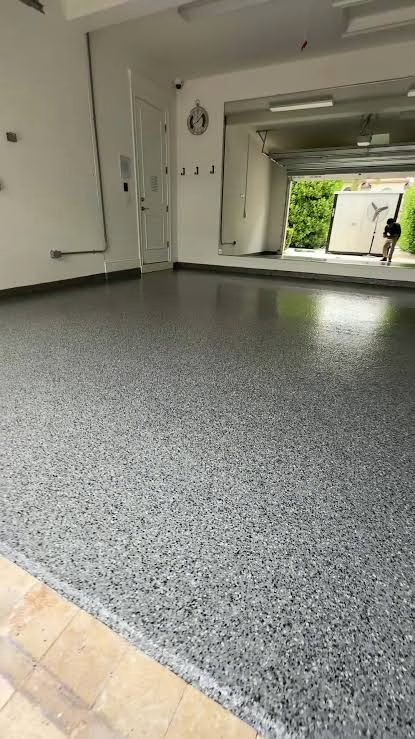
The flake system. Many garage floors use a base coat of epoxy with decorative vinyl flakes broadcast into it while wet, followed by a clear polyaspartic or urethane topcoat. The flakes add texture and hide dirt, and the topcoat provides UV stability and chemical resistance . This is the most common residential garage system.
What the coating does not fix. A coating is not a repair. Cracks, spalling, and moisture problems have to be addressed before the coating goes down. A coating over a failing slab will fail with the slab.
How a Garage Coating Project Runs
1. Assessment. We look at the slab, check for cracks, oil stains, and previous coatings, and test for moisture. This is where we decide whether a moisture-mitigating primer is needed.
2. Written estimate. The quote separates prep, repairs, primer, base coat, flakes, and topcoat so each part is visible.
3. Prep. The garage is cleared, oil and grease are removed, and the slab is ground. Cracks and pits are repaired. Dust is cleaned up before any coating is mixed.
4. Primer. If moisture readings call for it, a moisture-mitigating primer goes down before the base coat.
5. Base coat and flakes. The base coat is applied, and flakes are broadcast into it while it is still wet.
6. Topcoat. After the base coat cures, the clear topcoat goes on. This is what gives the floor its gloss and its resistance to UV and chemicals.
7. Cure. The floor cures before vehicles go back in. Cure time depends on the system and the conditions.
Repair and Maintenance for Coated Floors
A coated garage floor is not maintenance-free, but it is easier to maintain than bare concrete.
Hot tire pickup. This happens when hot tires soften a coating that is not fully cured or not rated for the heat. Polyaspartic topcoats resist it better than standard epoxy .
Scratches and chips. Small damage can sometimes be touched up with matching material. Larger areas may need a section recoat.
Delamination. If the coating lifts in sheets, moisture or prep failure is usually the cause. The affected area has to come up, the slab has to be dried and prepped, and the coating has to be reapplied.
Where a coating is not the answer. If the slab has active water intrusion or structural cracks, a coating will not solve it. The source has to be addressed first. In some cases, waterproof flooring installation in an adjacent space or a different surface treatment may be the better approach.
Garage Coatings in New Builds and Renovations
A garage coating is often part of a larger project. In new construction, the slab has to cure before coating, which means the coating is one of the last steps. In a renovation, the garage is usually empty and the timing is easier to control.
If the garage is attached to a house that is getting new flooring elsewhere, flooring for remodels is sequenced so the garage work does not interfere with the interior. If the project involves multiple trades, our flooring contractor page explains the broader scope.
For commercial garages and shops, commercial flooring services cover the larger scope and heavier traffic loads.
Areas We Serve
We provide garage floor coatings across the Wiregrass region. The links below go to location pages with details for each community.
If you are outside these communities, contact us to confirm whether your location is within our service area.
Frequently Asked Questions
Why do garage floor coatings peel or bubble?
Almost always because of moisture or poor prep. Concrete pushes water vapor up continuously. A coating traps that vapor, and the pressure builds until the coating lifts. Skipping moisture testing and surface grinding is the most common cause .
Do I need to test my slab before coating?
Yes. A plastic sheet test takes 24 hours and catches obvious moisture. Calcium chloride or relative humidity testing gives a number that tells you whether a moisture-mitigating primer is needed. Skipping the test risks a coating that fails months later .
What is the difference between epoxy and polyaspartic?
Epoxy is durable and less expensive but cures slowly and can yellow in UV light. Polyaspartic cures fast, resists UV and hot tire pickup, and tolerates humidity better during installation. It costs more, but the garage is back in use sooner .
How much does a garage floor coating cost in Dothan?
Local cost data puts epoxy garage floor coatings in Dothan at roughly $4 to $7 per square foot. A one-car garage runs about $1,100 to $1,700, and a two-car garage runs about $2,200 to $3,500 . Polyaspartic systems cost more than standard epoxy.
Can I coat over an existing coating?
Only if the existing coating is sound and properly bonded. A test patch is usually necessary. Loose or peeling coating has to come off first, and that often means grinding the slab back to bare concrete.
How long before I can park on a new coating?
It depends on the system. Polyaspartic coatings typically handle vehicle traffic in about a day. Epoxy systems take longer, often 72 hours or more. The manufacturer’s data sheet and the conditions during installation set the real number .
Can a garage floor coating be repaired?
Sometimes. Small chips and scratches can be touched up. Larger areas may need a section recoat. If the coating has delaminated in sheets, the affected area has to come up and the slab has to be dried and prepped again.
Do you install garage coatings during new construction or remodels?
Yes. In new construction, the slab has to cure before coating. In a remodel, the garage is usually empty and the timing is easier. Flooring for remodels is sequenced so the garage work does not interfere with the interior.