
Epoxy Floor Coatings

Epoxy Floor Coatings in Dothan, AL
Epoxy is a chemical reaction, not a paint. Two components mix, the chemistry starts, and the coating cures into a hard, bonded surface. That reaction is sensitive to three things: how much moisture is in the concrete, how the surface was prepared, and what the air and slab temperature are during installation. Get any of those wrong, and the coating fails in ways that cannot be repaired after the fact.
We install epoxy floor coatings across the Wiregrass with those three variables treated as the deciding factors. If you are planning a project, you can request an epoxy floor coating estimate and we will test the slab and check the conditions before recommending a system.
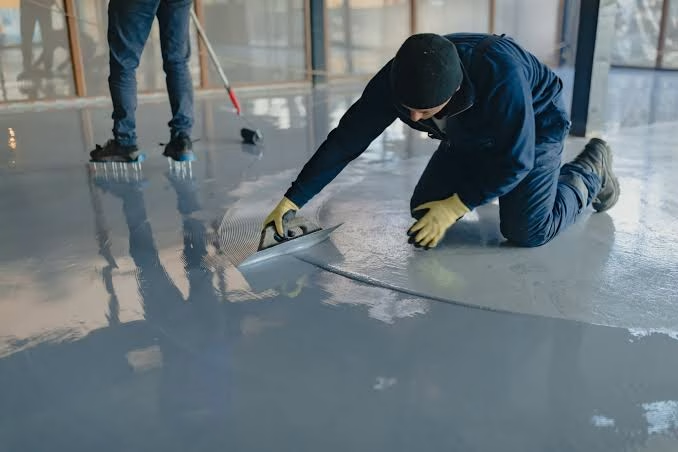
Epoxy Is Chemistry, Not Paint
Understanding what epoxy actually is explains why it behaves the way it does and why prep matters more than the product name.
Two components, one reaction. Epoxy comes as a resin and a hardener. When mixed in the correct ratio, the molecules cross-link and cure into a solid. The mixing ratio is not a suggestion; it is the chemistry. Off-ratio mixing produces a coating that never reaches full hardness or chemical resistance .
Pot life limits working time. Once mixed, epoxy has a limited window before it starts to set. A product with a 20-25 minute pot life at 73°F becomes unusable quickly if the slab is hot . In an Alabama summer, a hot slab can shorten that window dramatically. A crew that mixes more than it can spread in time wastes material and produces a patchy finish .
Temperature and dew point matter. Most epoxy products require substrate and ambient temperatures above 60°F, and the slab temperature must be at least 5°F above the dew point . Below those thresholds, the cure is compromised. Above the upper limit, the coating flashes off too fast and traps bubbles or cures with a porous surface.
Humidity affects the cure. Standard epoxy generally wants relative humidity below about 85 percent for a clean result . In a Wiregrass summer, that is not a given. High humidity can cause a hazy or blush finish on some epoxy systems, and it can interfere with how the coating sets
Why Epoxy Fails in Alabama
The failure modes are consistent, and they almost never start with the brand of coating.
Moisture vapor from the slab. Concrete is porous. Water moves through it as vapor, from wet soil toward drier air. A coating seals that vapor in. The pressure builds at the bond line, and the coating lifts in sheets. Alabama’s humid climate and clay-heavy soil keep the vapor drive steady, which is why moisture testing is not optional here .
Skipping the moisture test. A slab that looks dry on the surface can be wet inside. Calcium chloride testing and relative humidity probes give a number that tells you whether the slab is ready. Most systems want vapor emission under 3 pounds per 1,000 square feet per 24 hours, or internal relative humidity under 75 to 80 percent . A spot check with a plastic sheet catches obvious moisture, but it does not catch a slab with a dry skin over a wet core .
Poor surface preparation. Epoxy bonds to a profile, not to a smooth surface. A hard-troweled slab has a closed, slick surface that rejects coatings. Diamond grinding opens the concrete and creates the profile the epoxy needs. Acid etching is less consistent and does not remove oil, sealers, or curing compounds .
Applying over green concrete. Fresh concrete holds mix water. Manufacturer guidance generally calls for a minimum of 28 days of cure time, but 28 days is a floor, not a guarantee. A slab poured during a humid Alabama summer does not cure the same way as one poured in a dry fall. Moisture testing is the real readiness check, not the calendar .
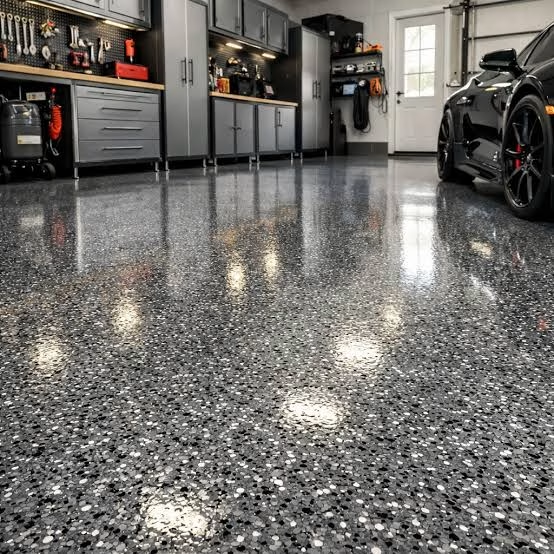
Testing the Slab Before Epoxy Goes Down
The test is the step that separates a coating that lasts from one that fails.
Calcium chloride testing. A dish of dry calcium chloride is weighed, sealed under a dome on the clean slab, and left for 72 hours. The weight it gains measures vapor emission from that patch of concrete. The number is the number. It does not care how the slab looks .
Relative humidity probes. A probe is drilled into the slab, usually to 40 percent of its depth, and left to equilibrate for three days. This reads moisture inside the concrete, not just at the surface. It catches the slab that would pass a surface test and fail in year two .
Plastic sheet test. A square of plastic taped to the slab for 24 hours. Condensation on the underside or darkened concrete underneath means moisture is moving. This is a screening step, not a final answer, but it catches the obvious cases before a crew mobilizes.
What the numbers decide. If readings are within the system’s limits, the epoxy can go down with a standard primer. If readings are high but not disqualifying, a moisture-mitigating primer is specified. If the readings are too high, the slab needs drying time or a different system entirely. The test result drives the scope.
Surface Prep That Makes Epoxy Bond
Prep is where most of the work happens and where most of the cost difference between quotes comes from.
Diamond grinding. The standard prep for a durable epoxy coating. Grinding removes the troweled skin, opens the pores, and creates a profile the epoxy can grip. It also removes old sealers, curing compounds, and surface contamination . The dust is managed with vacuum equipment.
Oil and grease removal. Degreasing comes before grinding. Oil that has soaked into the concrete has to be pulled out, or the epoxy will not bond in that spot. A garage that has held cars for years usually needs more degreasing than a new slab.
Crack and pit repair. Cracks are chased out and filled. Spalled areas are leveled. Older slabs typically need more of this than newer ones . Epoxy is not a filler; it is a coating. The surface has to be sound before the coating goes on.
Primer. Most epoxy systems require a primer coat. The primer is not optional, and it is not the same as the base coat. It seals the concrete, promotes adhesion, and in some systems provides the moisture mitigation.
Epoxy vs. Other Coatings
Epoxy is one option among several. The right one depends on the space and the conditions.
Epoxy. Durable, chemical-resistant, and less expensive than polyaspartic. It is the workhorse of industrial and commercial floors. The trade-offs are a longer cure time and a tendency to yellow in UV light. In a garage with windows, a polyaspartic topcoat is often specified over the epoxy base to provide UV stability.
Polyaspartic. Faster curing, UV-stable, and more tolerant of temperature and humidity during installation than standard epoxy . It resists hot tire pickup better. It costs more, but the space is back in use sooner. For a garage in Alabama humidity, polyaspartic is often the more reliable choice .
Urethane and hybrid systems. Some commercial and industrial floors use urethane topcoats over epoxy bases for chemical resistance and color stability. The system matters more than the individual product name.
Where epoxy is the wrong choice. A slab with active water intrusion, structural cracks, or ongoing hydrostatic pressure will push a coating off regardless of the product. The water source has to be addressed first. In some cases, a different surface treatment or a drainage correction is the better path.
How an Epoxy Coating Project Runs
1. Assessment. We look at the slab, check for cracks, oil stains, and previous coatings, and test for moisture. We also check the ambient conditions and the slab temperature against the product’s requirements.
2. Written estimate. The quote separates prep, repairs, primer, base coat, and any topcoat so each part is visible.
3. Prep. The space is cleared, oil and grease are removed, and the slab is ground. Cracks and pits are repaired. Dust is cleaned up before any coating is mixed.
4. Primer. The primer goes down and cures according to the product’s schedule.
5. Base coat. The epoxy is mixed to the exact ratio and spread within the pot life. The crew works in sections sized to the working time.
6. Cure. The coating cures before foot traffic or vehicle traffic. Cure time depends on the product and the conditions.
7. Walkthrough. We check the finish, the coverage, and the edges before final payment.
If the epoxy is part of a larger project, flooring for remodels is sequenced so the coating work happens after other trades are finished. For commercial and industrial floors, commercial flooring services cover the larger scope and heavier traffic loads.
Repair and Maintenance for Epoxy Floors
Epoxy is durable, but it is not indestructible. When it fails, the cause matters as much as the fix.
Hot tire pickup. A coating that has not fully cured softens under a hot tire. The tire lifts a patch, and the damage spreads. Polyaspartic topcoats resist this better than standard epoxy .
Scratches and chips. Small damage can sometimes be touched up with matching material. Larger areas may need a section recoat.
Delamination. If the epoxy lifts in sheets, moisture or prep failure is usually the cause. The affected area has to come up, the slab has to be dried and prepped, and the coating has to be reapplied. A spot repair over a moisture problem tends to fail again.
Where a coating is not the repair. If the slab has active water intrusion or structural cracks, a coating will not solve it. The source has to be addressed first. Waterproof flooring installation covers the products that handle moisture in other parts of the building.
Areas We Serve
We provide epoxy floor coatings across the Wiregrass region. The links below go to location pages with details for each community.
If you are outside these communities, contact us to confirm whether your location is within our service area.
Frequently Asked Questions
Why does epoxy peel or bubble?
Almost always because of moisture or poor prep. Concrete pushes water vapor up continuously. Epoxy traps that vapor, and the pressure builds until the coating lifts. Skipping moisture testing and surface grinding is the most common cause .
Do I need to test my slab before epoxy?
Yes. Calcium chloride or relative humidity testing gives a number that tells you whether the slab is ready. Most systems want vapor emission under 3 pounds or internal RH under 75 to 80 percent. A plastic sheet test is a screening step, not a final answer .
What is the difference between epoxy and polyaspartic?
Epoxy is durable and less expensive but cures slowly and can yellow in UV light. Polyaspartic cures fast, resists UV and hot tire pickup, and tolerates humidity better during installation. It costs more, but the space is back in use sooner .
How much does epoxy floor coating cost in Dothan?
Local cost data puts epoxy floor coatings in Dothan at roughly $4 to $7 per square foot. A one-car garage runs about $1,100 to $1,700, and a two-car garage runs about $2,200 to $3,500 . Flake systems and metallic finishes cost more.
Can epoxy go over an existing coating?
Only if the existing coating is sound and properly bonded. A test patch is usually necessary. Loose or peeling coating has to come off first, and that often means grinding the slab back to bare concrete.
How long before I can walk or park on a new epoxy floor?
It depends on the system. Standard epoxy typically allows foot traffic after about 18 hours and vehicle traffic after 48 hours or more. The manufacturer’s data sheet and the conditions during installation set the real number .
Can a failed epoxy floor be repaired?
Sometimes. Small chips can be touched up. If the coating has delaminated in sheets, the affected area has to come up and the slab has to be dried and prepped again. A spot repair over a moisture problem tends to fail again.
Do you install epoxy during new construction or remodels?
Yes. In new construction, the slab has to cure and test dry before coating. In a remodel, the space is usually empty and the timing is easier. Flooring for remodels is sequenced so the coating work does not interfere with other trades.