
Hardwood Flooring Installation

Hardwood Flooring Installation in Dothan, AL
Wood is the only flooring material that keeps changing after it leaves the mill. It takes on moisture, gives it back, expands in summer, and tightens in winter. A hardwood floor that looks perfect on installation day can develop gaps and cupping a year later if the wood was not acclimated, the subfloor was not dry, or the wrong product went into the wrong room.
We install solid and engineered hardwood in homes across the Wiregrass, and we treat acclimation and moisture testing as part of the job rather than a step to skip. If you are planning a wood floor, you can request a hardwood flooring estimate and we will assess the space before recommending a product.

Solid vs. Engineered: Which Wood Belongs in Your Home
These two products look similar on the showroom floor and behave very differently once installed. Choosing between them is the first real decision in a hardwood project.
Solid hardwood. One piece of wood, usually three-quarters of an inch thick, milled from a single species. It can be sanded and refinished multiple times over its life, which is why it lasts for decades. However, it moves with humidity and is not suitable for basements, slabs, or rooms with wide moisture swings. Solid hardwood installation works best above grade with reliable climate control.
Engineered hardwood. A real wood veneer bonded to a plywood core. The cross-layered core resists moisture movement far better than solid wood, which makes engineered hardwood flooring the practical choice for slab foundations, below-grade rooms, and homes where humidity is harder to control. It can be refinished once or twice depending on veneer thickness.
Where each makes sense in Alabama. In the Wiregrass, humidity runs high for most of the year. Solid wood works in living rooms and bedrooms with central air and stable moisture. Engineered wood is the safer choice for kitchens, sunrooms, and any room where the climate is less controlled.
Species, Grade, and Finish: What Actually Matters
Walk into any flooring showroom and the options multiply fast. Most of them matter less than the three factors below.
Species hardness. Oak, hickory, and maple are harder than walnut or cherry. Harder species resist dents better in homes with pets or heavy traffic. Softer species look beautiful but show wear faster. We match species to the room rather than to a catalog photo.
Grade and character. Clear grade is uniform and calm. Character grade shows knots, mineral streaks, and color variation. Neither is better — it is a preference, and it affects the final look more than the species does.
Finish. Factory-finished planks arrive with the finish already applied and are faster to install. Site-finished floors are sanded and sealed on site, which allows a custom color and a perfectly flat surface across the whole floor. Hardwood floor refinishing uses the same sanding and finishing process on existing floors.
Plank width and layout. Wider planks show fewer seams and look more contemporary. Narrower planks are traditional and more stable in humid conditions. Layout direction affects how a room reads, and it should be decided before installation starts.
Why Acclimation Is Not Optional in Alabama
Acclimation means letting the wood sit in the room where it will be installed long enough to reach the same moisture content as the surrounding air. Skip it, and the floor will move after installation instead of before.
What happens without acclimation. Wood installed while still holding mill moisture will shrink as it dries in the home. The result is gaps between planks, squeaks, and in worse cases, cupping at the edges. The floor does not fail on day one — it fails six months later, after the homeowner has paid and moved on.
How long it takes. Usually several days, depending on the species, thickness, and the difference between the wood’s moisture content and the room’s. Engineered products acclimate faster than solid, but they still need time.
What we check. Moisture content of the wood, moisture content of the subfloor, and the relative humidity in the room. If those numbers do not line up, the wood keeps sitting until they do. This step is why a hardwood installation takes longer than a laminate installation of the same square footage.
Subfloor Requirements for Wood Floors
Wood needs a flatter, drier, more stable substrate than most other flooring materials. This is where a lot of residential hardwood projects get into trouble.
Flatness. Wood floors follow the surface beneath them. A subfloor that is out of flat by more than a small tolerance will show as a visible dip or hump in the finished floor. Floor leveling corrects this before installation.
Moisture. Wood subfloors and concrete slabs both have to be within a safe moisture range. On slabs, that means testing and possibly installing a moisture barrier. Subfloor repair handles any soft or damaged sections found during inspection.
Fastening. Nail-down, staple-down, glue-down, and floating are the four common installation methods. The right one depends on the product, the subfloor, and the room. The installation method is decided before materials are ordered, not on the day of work.
Existing flooring. Sometimes old flooring has to come out before wood goes down. Flooring removal and disposal are part of the project when the existing surface cannot serve as a base.
How a Hardwood Installation Runs
1. In-home assessment. We measure the rooms, check the subfloor for flatness and moisture, and discuss species and product options. This is also when we flag whether subfloor repair is likely.
2. Written estimate. The quote separates materials, labor, subfloor work, and finishing so each part of the job is visible.
3. Material order and delivery. Wood is ordered and delivered to the home, where it sits to acclimate. This is scheduled into the timeline rather than compressed.
4. Removal and prep. Existing flooring comes up if needed, and the subfloor is leveled and cleaned. Flooring removal and disposal are handled by the crew.
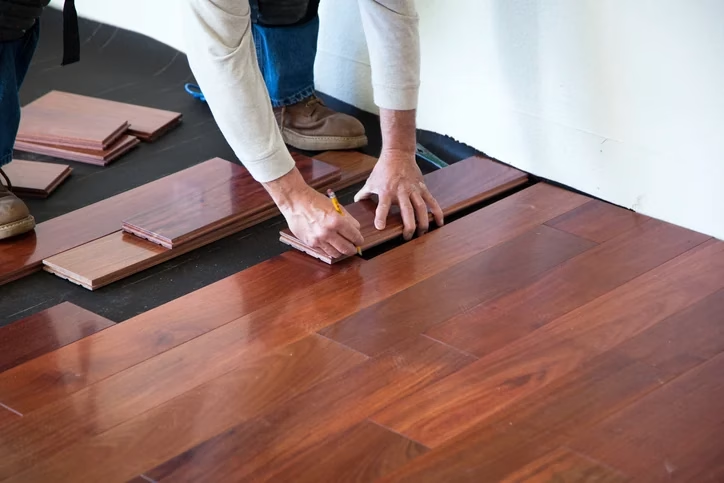
5. Installation. Planks go down using the specified method — nail, staple, glue, or float. Transitions to other rooms are fitted, and trim is reinstalled or replaced.
6. Finishing or cleanup. Factory-finished floors are cleaned and ready to walk on. Site-finished floors get sanded, stained, and sealed, with drying time built into the schedule.
7. Walkthrough. We walk the finished space with you and address anything that needs adjustment before final payment.
Wood in Kitchens, Bathrooms, and High-Traffic Rooms
Hardwood is often assumed to be a living-room-only material. That is not quite true, but it does require honest boundaries.
Kitchens. Kitchen flooring installation in wood is possible with engineered products and prompt cleanup of spills. Solid wood in a kitchen is riskier because of dishwasher and sink leaks, but it is not impossible with good ventilation and a stable climate.
Bathrooms. Generally not recommended. Bathroom flooring installation should default to tile or LVP because of steam and splash. If the bathroom is being renovated, tile shower installation and backsplash tile installation pair better with a wood floor in the adjoining room.
High-traffic hallways and living areas. Hardwood floor installation handles this well when the species is hard enough. Oak and hickory wear better than softer species in these zones.
Homes with pets. Wood scratches. It can be refinished, but refinishing is not free. Luxury vinyl plank flooring is the practical alternative in homes with large dogs or high-energy pets.
Repair, Refinish, or Replace an Existing Wood Floor
Not every worn wood floor needs to be replaced. The right answer depends on how much sound wood is left.
Repair. Loose boards, a few damaged planks, or a small area of subfloor repair can often be fixed with floor repair rather than a full replacement.
Refinish. Solid hardwood that is structurally sound but worn or discolored can be sanded and refinished with hardwood floor refinishing. This is the most cost-effective option when the wood is still solid. Engineered wood can sometimes be refinished once, depending on veneer thickness.
Replace. When the wood is water-damaged, cupped beyond repair, or too thin to sand again, floor replacement is the practical answer. That scope includes removal, subfloor prep, and new installation.
The assessment visit determines which option applies. The estimate should state the answer clearly rather than leaving it vague.
Areas We Serve
We provide hardwood flooring installation across the Wiregrass region. The links below go to location pages with details for each community.
Frequently Asked Questions
How long does hardwood flooring installation take?
Installation itself is usually fast once the wood is acclimated. The full timeline includes acclimation, subfloor prep, installation, and finishing for site-finished floors. The estimate should give a realistic schedule from delivery to walkthrough.
Is solid or engineered hardwood better in Alabama?
Engineered is usually more stable in humid conditions and on slab foundations. Solid wood works well above grade with reliable climate control. Engineered hardwood flooring is the safer default in the Wiregrass.
Why does acclimation matter so much?
Wood moves with humidity. Acclimating lets the wood reach the moisture content of the room before installation, so it moves before it goes down rather than after. Skipping it causes gaps and cupping months later.
Can hardwood go in a kitchen or bathroom?
Kitchens are possible with engineered products and good ventilation. Bathrooms are generally not recommended because of steam and splash. Waterproof flooring installation is the safer choice in wet rooms.
Do you repair or refinish existing hardwood?
Yes. Hardwood floor refinishing restores solid wood that is still structurally sound. Floor repair handles smaller issues like loose boards or localized damage.
Do you handle subfloor preparation for wood floors?
Yes. Floor leveling and subfloor repair happen before installation so the finished floor is flat and stable.
Can you install hardwood over an existing floor?
Sometimes, depending on the existing surface, its condition, and the installation method. Flooring installation over an existing floor is a different scope and carries different risks.
Do you install hardwood during remodels or new construction?
Yes. Flooring for remodels is sequenced around other trades, and new construction flooring is coordinated with the builder’s schedule.